

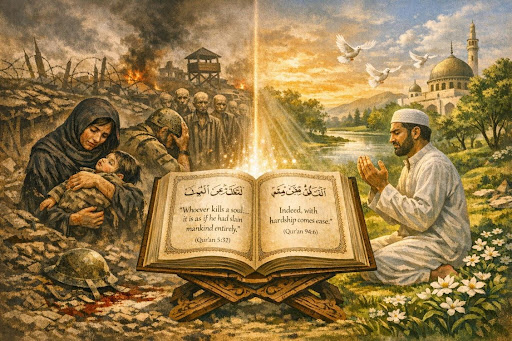
The Invisible Scars of War What Today’s Middle East Conflicts Mean for Our Future
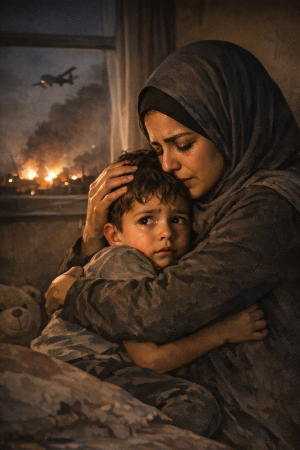
Scars of War : A little boy wakes up suddenly in the middle of the night. The sound of an explosion echoes in the distance. His mother quickly pulls him close and whispers, “It’s okay, it’s just thunder.”
But it isn’t thunder.
It is war.
For many families across the Middle East today, this scene is not imagination. It is daily life. Children fall asleep to the sound of drones. Parents carry the unbearable fear of losing everything in a moment.
War does not only destroy buildings or borders. It quietly breaks something deeper, the human mind and soul.
The conflicts unfolding today in places like Gaza, Syria, and Yemen are not just political events. They are shaping the psychological future of millions of people. And the consequences may last for generations.
War Has Never Been Kind to Humanity
History tells us a simple truth: war has never truly solved human suffering.
From the devastation of World War I, where soldiers returned home with what doctors called “shell shock,” to the trauma carried by survivors of World War II, the Vietnam War, and countless regional conflicts, psychological wounds have always followed warfare.
Today, we understand these invisible wounds better. They are often diagnosed as Post-Traumatic Stress Disorder (PTSD).
Studies estimate that 15% to 36% of people exposed to armed conflict develop PTSD, compared to less than 8% in the general population (Steel et al., 2009).
But PTSD is only part of the story.
War also leaves behind grief, fear, anger, and moral confusion, emotional scars that can last long after the fighting ends.
The Middle East Today: A Crisis Beyond Borders
The current conflicts in the Middle East are among the most devastating humanitarian crises of our time. Millions have been displaced, entire neighborhoods reduced to rubble, and families separated across borders.
Yet the greatest damage may be psychological.
Children growing up in war zones experience constant uncertainty, loss, and fear. Many witness violence before they even understand what it means.
Psychologists warn that prolonged exposure to war can lead to Complex PTSD, a condition caused by repeated trauma over time (World Health Organization, 2019). Unlike typical PTSD, complex trauma affects identity, relationships, and emotional stability.
In other words, war does not just hurt people in the present, it reshapes their future.
The Qur’anic View on War and Human Suffering
Islam does not glorify war. In fact, the Qur’an repeatedly reminds humanity that peace and justice are the ultimate goals.
Allah says:
“Whoever kills a soul… it is as if he had slain mankind entirely.”
(Qur’an 5:32)
This verse highlights the sacred value of human life. Every life lost in conflict is not just a statistic, it is a world extinguished.
The Qur’an also emphasizes patience and compassion in times of suffering:
“Indeed, with hardship comes ease.”
(Qur’an 94:6)
For many people living through war, faith becomes a source of emotional survival. It gives meaning to suffering and hope for eventual justice.
Yet faith alone cannot erase trauma. The psychological wounds of war still require understanding, care, and healing.
The Invisible Injury: Moral Trauma
One of the lesser-known psychological effects of war is moral injury.
Moral injury occurs when individuals experience events that violate their deepest moral beliefs (Litz et al., 2009).
A soldier who accidentally harms civilians may carry overwhelming guilt for years. A father who cannot protect his family may feel unbearable shame. A humanitarian worker who witnesses suffering without being able to stop it may struggle with helplessness.
These experiences attack a person’s sense of identity and morality.
They raise painful questions:
Why did this happen?
Why couldn’t I stop it?
Where was justice?
Such questions can haunt survivors long after the war ends.
War Trauma Is Not Limited to Soldiers
When people imagine war trauma, they often think of soldiers returning from battle.
But in modern conflicts, civilians are often the most affected.
Schools, hospitals, and homes are destroyed. Families flee with nothing but the clothes they are wearing. Children grow up without stability or security.
Refugees face another layer of hardship.
Even after escaping violence, many struggle with poverty, discrimination, and uncertainty in new countries. Research shows that the conditions refugees face after displacement significantly influence their psychological recovery (Porter & Haslam, 2005).
Without proper support, trauma can follow them for decades.
The Next Generation of Trauma
Perhaps the most heartbreaking impact of war is what it does to children.
Children who grow up surrounded by violence often experience:
- chronic anxiety
- emotional numbness
- nightmares
- difficulty trusting others
- problems with education and development
These psychological wounds do not simply disappear as children grow older.
Instead, trauma can be passed down through generations. Communities affected by war may continue to struggle with fear, instability, and social tension long after the conflict ends.
This is why today’s wars in the Middle East are not just regional tragedies.
They are shaping the psychological future of the world.
Healing the Wounds of War
Despite the darkness of war, healing is possible.
Modern psychological treatments such as Trauma-Focused Cognitive Behavioural Therapy (TF-CBT) and Eye Movement Desensitization and Reprocessing (EMDR) have proven effective for treating PTSD (National Institute for Health and Care Excellence, 2018).
Technology may also help expand access to mental health care. Online therapy platforms and mobile applications are being developed to support trauma survivors in regions where professional services are limited.
However, mental health treatment alone cannot solve the deeper problem.
The ultimate solution to war trauma is preventing war itself.
A Lesson Humanity Still Has Not Learned
Today, more than fifty armed conflicts are occurring across the world.
Despite centuries of history, humanity continues repeating the same cycle, violence followed by grief, rebuilding followed by new destruction.
But the Qur’an reminds us that oppression and injustice cannot last forever.
“And do not think that Allah is unaware of what the wrongdoers do.”
(Qur’an 14:42)
For the families living under bombs today, hope may feel distant. Yet every act of compassion, justice, and understanding brings the world one step closer to peace.
Because long after wars end, the greatest challenge remains the same: Healing the invisible scars left in the human heart.
References
Litz, B. T., Stein, N., Delaney, E., et al. (2009). Moral injury and moral repair in war veterans. Clinical Psychology Review, 29(8), 695–706.
National Institute for Health and Care Excellence. (2018). Post-traumatic stress disorder (NICE guideline NG116).
Porter, M., & Haslam, N. (2005). Predisplacement and postdisplacement factors associated with mental health of refugees. Journal of the American Medical Association, 294(5), 602–612.
Steel, Z., Chey, T., Silove, D., et al. (2009). Association of torture and trauma with mental health outcomes among populations exposed to mass conflict. JAMA, 302(5), 537–549.
Williamson, V., & Murphy, D. (2025). Psychological consequences of global armed conflict. BMC Medicine.
World Health Organization. (2019). International Classification of Diseases (ICD-11).
The Invisible Scars of War What Today’s Middle East Conflicts Mean for Our Future


Comment (1)
Beyond Profit: The Role of Ethics, Faith, and Stakeholders
says April 01, 2026 at 12:56 pm[…] For example, industries that produce unhealthy food have impacted public health. Similarly, pollution from factories, excessive waste, and overuse of natural resources have harmed the environment. Oceans filled with plastic, polluted air, and climate change are not just random problems, they are … […]